
Braided Syntegration is a form of Hitchhiker Syntegration designed for 42 beings: - 35 human participants. - 7 Hitchhikers. It is called braided because the intelligence of the event does not come only from what is said inside a single session. It comes from the weaving of many participant journeys across time. Each person moves through a sequence of topic conversations. Each topic is held in continuity by a Hitchhiker. Across successive rounds, the paths of participants cross and recross until the whole event becomes a woven field of encounters.
Classical Syntegration uses the Icosahedron to structure simultaneous topic relationships. Braided Syntegration uses a different principle. It uses repeated small-group encounters across time, held together by topic continuity, rotating human participation, and documentary memory.
The result is not a static geometry but a living fabric.
# Core Numbers A standard Braided Syntegration uses: - 35 humans - 7 Hitchhikers - 9 rounds and 9 topics. - 7 simultaneous Cells per round
Each Cell contains: - 5 humans and 1 Hitchhiker. This gives 42 beings in the field at any one time, while keeping each live conversation to 6 or under.
# Why These Numbers Matter The design is shaped by two requirements. 1. The first is that every human participant should visit every topic conversation. 1. The second is that every human participant should meet every other human participant, while staying in groups of 6 or under. With 35 humans, each participant has 34 other humans to meet. In a Cell of 5 humans, each round allows a participant to meet 4 other humans. Over 9 rounds, each participant has 36 encounter slots. That is enough to meet all 34 others, with a small amount of repetition left over. This is why 35 humans and 9 rounds form such a clean fit.
# The Difference from Classical Syntegration In classical Syntegration, a participant usually encounters only part of the whole field, but does so through a carefully structured role system. The geometry itself distributes the relationships. In Braided Syntegration, the participant journey is broader. Every human visits every topic. The whole field is encountered directly, but not all at once. This shifts the centre of gravity.
In classical Syntegration: - geometry holds the topic relations. - participants move through a subset of the field. In Braided Syntegration: - the rounds hold the sequence. - Hitchhikers hold the topics. - participants braid the field by moving through all of it.
So the structure is less like a solid and more like a loom.
# The Role of the Hitchhikers The 7 Hitchhikers are not decorative. They are the stable frame of the process. Each Hitchhiker: - holds a Cell in each round. - carries continuity of tone, memory, and provocation. - works with an agent and media layer. - helps preserve the identity of a topic as different human participants rotate through it. The Hitchhiker is therefore not just a facilitator. A Hitchhiker is part topic-holder, part witness, part archetypal challenger, part recorder of continuity. A topic in Braided Syntegration is not held by a fixed human membership. It is held by a Hitchhiker.
# Topics and Rounds A standard form uses 9 topics across 9 rounds. Each round activates 7 Cells. Not every topic must appear in every round, but over the full cycle each participant visits all 9 topic conversations once. This means that a participant’s path is not random. It is a designed traversal through the field. - The field is therefore both spatial and temporal. - Spatially, in any round there are 7 live Cells. - Temporally, across the whole event, there are 9 passes through the system. - The full event is the combination of both.
# Cells A Cell is the basic live conversation unit. Each Cell contains: - 5 humans. - 1 Hitchhiker. The small scale is deliberate. A group of 6 or under makes it easier to listen, harder to hide, and easier to film or document with some fidelity. Within a Cell, the 5 humans may be assigned hats such as: - Head, Heart and Hands - Heart of Gold - a further rotating role such as witness, jester, translator, or implementer. These hats do not define the whole identity of the participants. They are temporary emphases that help the Cell metabolise different modes of knowing. The Hitchhiker brings provocation, continuity, and memory into this local ecology.
# Braiding The braid is formed by participant movement. A participant does not stay with one topic. They pass from one topic conversation to another across rounds. As they move, they carry traces: - a phrase from one Cell into another. - a contradiction from one topic into a second. - an unresolved tension from one round into a later one. - a comparison between two conversations that did not otherwise meet. This is the essence of braiding. The system does not rely only on summaries from above. It relies on humans becoming carriers of relations. Each participant becomes a thread.
# Pairing and Encounter Because the design also aims for every participant to meet every other participant, the movement of humans between Cells is not only about topic coverage. It is also about social coverage. This gives the schedule a second duty. It must ensure that over the whole process: - every person visits every topic. - every person also encounters every other person. This is why the braid cannot be improvised carelessly. It must be designed as a pairing structure. The topic journey and the social journey are woven together.
# Asynchronous Time Braided Syntegration is especially suited to asynchronous work. The rounds do not need to happen in one intense burst. They can be spread across days or weeks. This gives participants time to: - reflect - revisit media from earlier Cells - carry ideas more consciously - make the later rounds richer than the first Asynchronous time changes the character of the event. The process becomes less like a conference and more like a gradual weaving. Meaning is not only produced in the room. It is also produced in the intervals.
# Media and Agents Because the process unfolds through time, memory cannot depend only on human recollection. Each Hitchhiker should therefore work with: - an agent layer for summaries, pattern tracking, and prompts. - a documentary layer for clips, notes, and recorded interventions. - a linking layer that turns the evolving record into a Guide or Media HyperGraph. This means the braid exists in three forms at once: - in the live encounters - in the participant memory - in the media trace The media trace matters because it lets later participants and later publics follow the weave.
# What Braided Syntegration Does Well Braided Syntegration is especially strong when the aim is to combine: - small-group depth - whole-field exposure - strong circulation of ideas - broad social mixing - archetypal continuity through Hitchhikers - documentary capture and later navigation It is a good design when one wants the event to feel both intimate and systemic.
# Risks The main risk is that the braid becomes only logistical and not meaningful. - If participant movement is treated as mere scheduling, then the system may produce social novelty without intellectual consequence. - A second risk is Hitchhiker dominance. If the Hitchhikers become the only true carriers of continuity, then the human participants may become visitors rather than co-weavers. - A third risk is weak memory. If the media and agent layers are poor, then later rounds may lose the texture of earlier ones. - A fourth risk is thin topics. If the topics are badly chosen, then visiting them all once may produce breadth without enough depth.
# Design Principle The design principle of Braided Syntegration is simple. No one holds the whole. No one stays still. The intelligence of the system emerges because the same field is encountered by many different paths, and those paths are woven together over time.
# The Heptagonal Loom The Heptagonal Loom is the geometry used to visualise and organise Braided Syntegration. It is called heptagonal because the live structure of each round is based on 7 Cells, each held by one of the 7 Hitchhikers. It is called a loom because the event is not a static object but a repeated weaving process. - The Hitchhikers form the stable frame. - The humans form the threads. - The rounds form the passes of the shuttle. - The final fabric is the deliberation.
# One Round A single round of the Heptagonal Loom consists of 7 Cells. Each Cell contains:
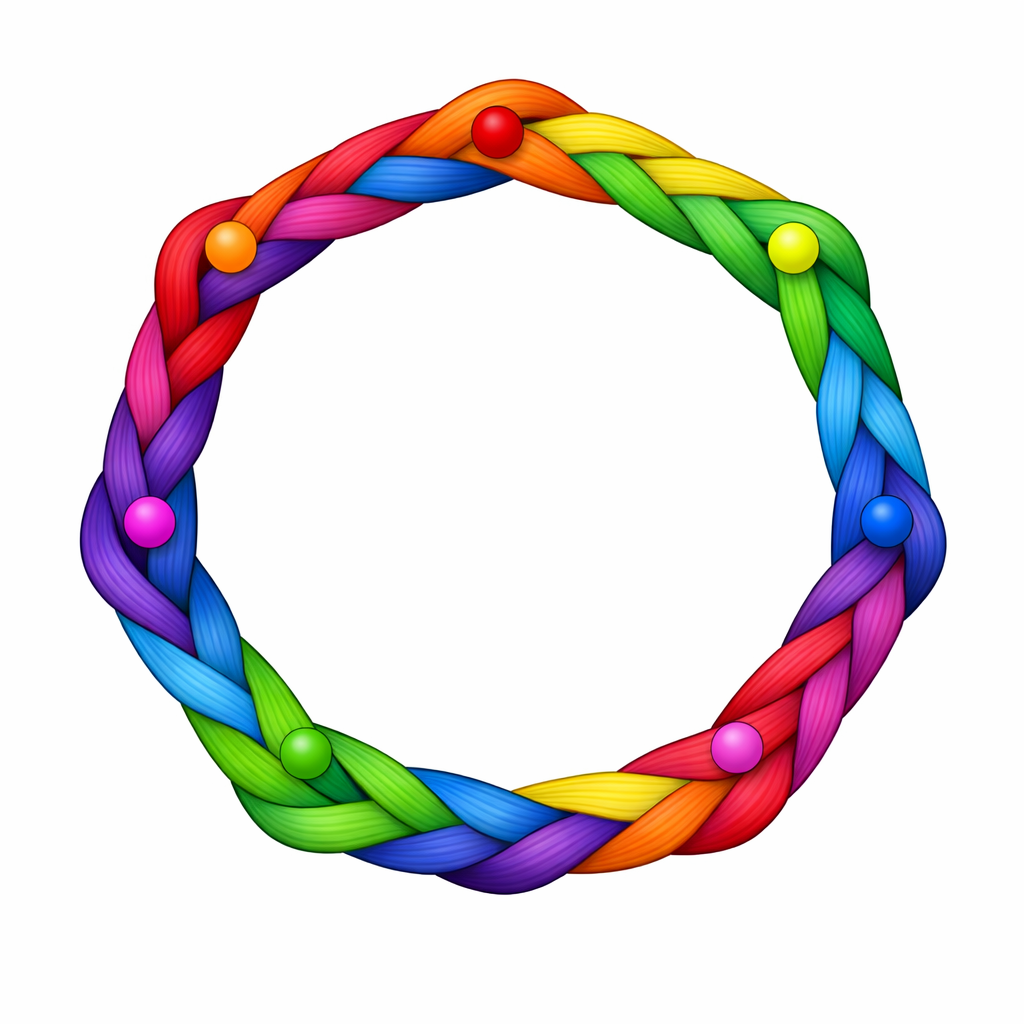
Braided Loom with 35 particpants and 7 Hitchhikers over 9 rounds and 9 topics.
- 1 Hitchhiker - 5 humans
This means one round can be pictured as a heptagon of Cells. Each point on the heptagon is one live conversation.
But each point is not a single node. It is a little social cluster, a mini-constellation of one Hitchhiker and five humans.
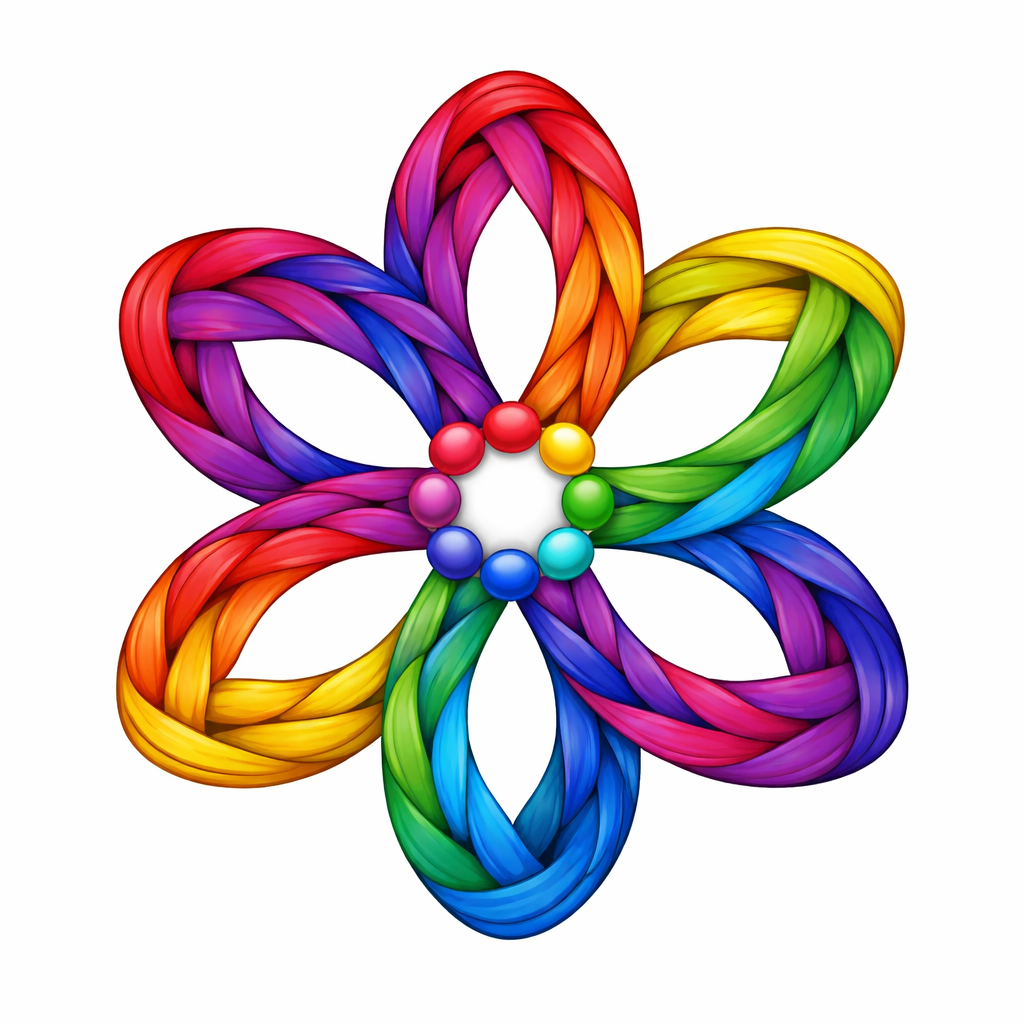
One rouhnd of the Briaded Loom with 35 particpants and 7 Hitchhikers in 9 topics.
So a round is both: - a ring of 7 Cells - a flower of 7 petals
Both images are useful.
# The Stable Frame The reason the loom image works is that the 7 Hitchhikers remain the most stable feature in the structure. - They are the pegs of the loom. - They hold topic continuity. - They preserve memory. - They help keep the field coherent even though the 35 humans are constantly moving. - Without them, the system would risk becoming a mere round-robin discussion design. - With them, it becomes a held field.
# The Threads The humans are the threads. A thread becomes visible not in one Cell but across many rounds. To understand the loom properly, one must look not only at the ring of a single round but at the trajectories of participants across the full sequence. One participant may move from Topic A to Topic D to Topic G, carrying an ethical tension. Another may move from Topic B to Topic E to Topic H, carrying a practical objection. Another may move from Topic C to Topic F to Topic I, carrying a poetic phrase that unexpectedly becomes constitutional language. These crossings are what make the loom a braid rather than a set of separate workshops.
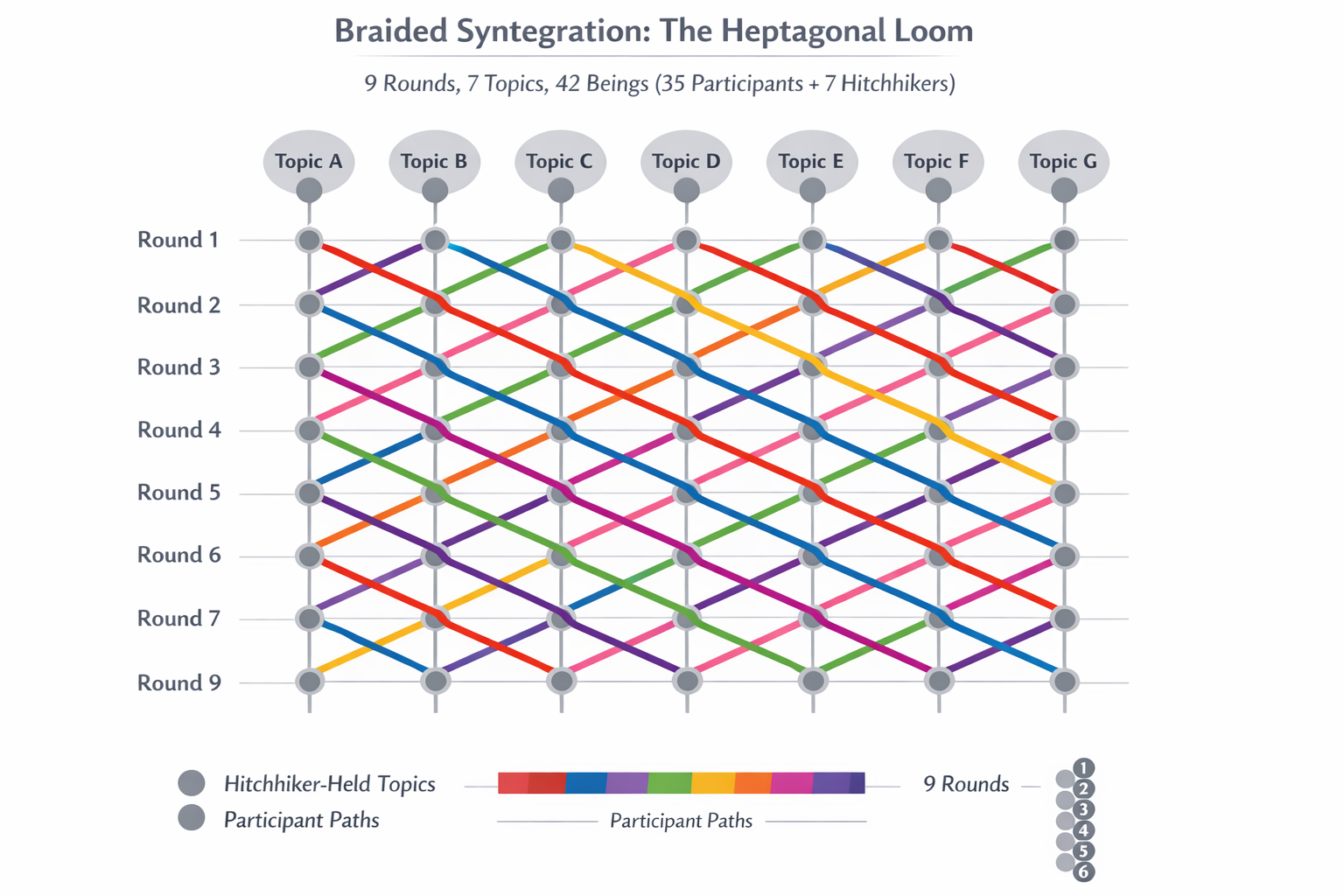
Braided Loom showing 9 rounds.
# The Nine Passes In the standard design, the loom is worked through 9 passes. These 9 rounds are the shuttle-passes of the loom. Each pass rearranges the 35 human threads around the 7 Hitchhiker-held Cells. By the end: - each participant has visited every topic. - each participant has met every other participant. - each topic has been encountered by many different constellations of people. - the whole field has been woven into a shared fabric of memory. This is why the loom is a more accurate image than a solid. - A solid is finished and fixed. - A loom is active, sequential, and cumulative.
# Spatial and Temporal Geometry The Heptagonal Loom has two geometries. - The first is spatial. - At any one moment, it is a heptagon of 7 Cells. The second is temporal. Across the full event, it is a layered lattice of rounds and participant paths. One can think of the whole thing as a 7 by 9 field. The Cells form the stable positions. The participants form the moving lines through that field. So the event can be drawn in at least three ways: - as a heptagonal ring for one round. - as a flower of 7 Cells for a more ceremonial image. - as a braided lattice across 9 rounds for the full process. All three are true.
# Why Not an Icosahedron Classical Syntegration is beautifully served by the Icosahedron because its method depends on simultaneous linked topic relations. The Heptagonal Loom does something different. It sacrifices some simultaneity in order to gain: - full topic exposure. - full social encounter coverage. - smaller conversation groups. - stronger suitability for asynchronous work. - easier integration of documentary media and agents. So the Heptagonal Loom is not a failed icosahedron. It is a different geometry for a different mode of collective intelligence.
# The Loom as Public Form The Heptagonal Loom is not only an internal organisational device. It is also a public image. It gives people a way to understand the event: - 7 Hitchhikers holding 7 Cells. - 35 humans moving through them. - 9 rounds of weaving. - a final fabric of shared understanding. It is therefore useful both operationally and symbolically. Operationally, it helps design schedules, role assignments, and coverage. Symbolically, it tells the story of the event in a legible way.
# The Fabric The final output of the loom is not only consensus. It may include: - revised questions. - legal poems. - design principles. - contradictions that remain unresolved. - films. - maps. - a Guide that lets others navigate the braided record. The fabric is therefore not a final answer. It is the durable pattern left behind by the weaving.
# Design Principle The design principle of the Heptagonal Loom is this. Hold continuity in a few stable nodes. Let many human threads move through them. Repeat the passes until encounter becomes fabric.