
In geometry, an __icosahedron__ is a polyhedron with 20 faces. The name comes from Ancient Greek εἴκοσι (eíkosi) meaning "twenty" and from Ancient Greek ἕδρα (hédra) meaning "seat" - wikipedia 
# In Simple Terms In Syntegration: - 12 vertices become 12 topics. - 30 edges become structured links between topics. - participants move through these linked topics in different roles. - the whole event becomes a distributed conversation rather than a sequence of separate meetings. So the icosahedron is the hidden skeleton of the method. It gives the conversation a shape that helps many voices think together.
# Icosahedron in Syntegration An Icosahedron is the geometric backbone of Syntegration. Stafford Beer did not use it because it looks elegant. He used it because its pattern of connections helps structure a conversation so that variety can circulate without collapsing into hierarchy. A regular icosahedron has: - 20 triangular faces. - 12 vertices. - 30 edges. In ordinary geometry these are just parts of a solid. In Syntegration they become a communication design.
# Why This Shape Matters Syntegration is trying to solve a practical problem. How can a group of people explore many linked issues without ending up with either chaos or a central controlling voice. The icosahedron helps because it is highly symmetrical. No vertex is privileged. No edge is unique. No face is the centre. This makes it a good model for a non-hierarchical discussion structure. Its geometry distributes relationships evenly. That is what Beer wanted. He wanted a structure where participants could meet several themes, where themes could influence one another, and where the whole process could hold complexity without requiring a single commander.
# How Syntegration Uses It In the classic form of Syntegration, the **12 vertices** are used as **12 topics**. These are not random topics. They are chosen because together they represent the key dimensions of the issue being explored. The **30 edges** then represent the links between those topics. Each topic is directly connected to 5 others, because each vertex of an icosahedron touches 5 edges. This means every topic has: - 5 immediate neighbouring topics. - indirect pathways to all the others. - no special central dominance. So if one group is discussing Topic A, it is not isolated. Its work is structurally related to 5 nearby topics, and through them to the whole field.
# People and Roles Syntegration does not simply assign one team to one topic and leave them there. That would create silos. Instead, participants are distributed across the 12 topic nodes in different roles. A person may be: - a member in one topic group. - a critic in another. - an observer in another. Because people cross between topics, the geometry becomes active. The icosahedron is not just a map of issues. It becomes a map of how insight travels. An idea raised in one node can be challenged in another, echoed in a third, and returned in transformed form. This reverberation is one of the main purposes of the design.
# Why Not Just Use Breakout Groups A normal workshop might also have several breakout groups, but these often become disconnected. Each table produces its own notes, then someone tries to summarise them afterwards. Syntegration is different. The icosahedral structure is there to prevent isolation from the beginning. Because each topic touches 5 others, and because participants rotate through linked roles, the conversation is designed to circulate. The structure itself encourages cross-pollination. > So the icosahedron is not a symbol. It is a machine for distributing attention.
# Faces and the Bigger Pattern The **20 faces** are less often emphasised in simple explanations, but they matter because they show how triples of topics meet. Each triangular face joins 3 vertices, so it can be seen as a small cluster of related issues. This means Syntegration does not only connect pairs of topics through edges. It also creates little triangular neighbourhoods in which three concerns can interact. That gives the structure depth. It is not merely a list of pairwise links. It is a woven field.
# What the Geometry Achieves The icosahedron gives Syntegration several useful properties: - balance, because each topic has the same formal status. - connectivity, because each topic touches 5 others directly. - circulation, because people move across linked topics. - non-centrality, because there is no single top or command point. - coherence, because the whole conversation is one structure rather than many isolated sessions. This is why Beer chose geometry. He wanted a disciplined way to organise complexity so that intelligence could emerge from the pattern of relations itself.
> Magic Number: Five fits nicely into an icosahedron. Twelve topics, five participants, each participant involved in two topics. Each topic connected to five others through one participant.
digraph { layout=circo rankdir=LR overlap=false concentrate=false //bgcolor=lightblue // splines=" " node [shape=box style=rounded] label=" \nIcosahedron 12 Nodes (Topics) / 30 Edges (Participants)/ 5 Members per Node (Conversations)/ 2 Nodes per Member" "TOPIC 1" -> {"PERSON 1" "PERSON 2" "PERSON 3" "PERSON 4" "PERSON 5"} [color=red penwidth=5] #B -> {1 6 7 8 27} [color=orange penwidth=5] #C -> {2 6 29 11 12} [color="#eed200" penwidth=5] #D -> {3 7 10 18 14} [color="#fced42" penwidth=5] #E -> {4 10 15 16 28} [color=purple penwidth=5] #F -> {5 9 11 15 19} [color=lightblue penwidth=5] #G -> {13 16 17 14 30} [color=blue penwidth=5] #H -> {22 12 24 25 9} [color=green penwidth=5] #Ii -> {17 24 19 26 28} [color=brown penwidth=5] #J -> {8 13 18 20 21} [color=black penwidth=5] #K -> {22 27 23 20 29} [color=gray penwidth=5] #L -> {30 21 26 25 23} [color=violet penwidth=5] //node {[shape=circle] A B C D E F G H Ii J K L} "TOPIC 1" [shape=triangle style=filled color=red fontcolor=white] #B [shape=triangle style=filled color=orange] #C [shape=triangle style=filled color="#eed200"] #D [shape=triangle style=filled color="#fced42"] #E [shape=triangle style=filled color=purple fontcolor=white] #F [shape=triangle style=filled color=lightblue] #G [shape=triangle style=filled color=blue fontcolor=white] #H [shape=triangle style=filled color=green1] #Ii [shape=triangle style=filled color=brown fontcolor=white] #J [shape=triangle style=filled color=black fontcolor=white] #K [shape=triangle style=filled color=grey fontcolor=white ] #L [shape=triangle style=filled color=violet] "TOPIC 1" [label="TOPIC 1"] #B [label="TOPIC 2"] #C [label="TOPIC 3"] #D [label="TOPIC 4"] #E [label="TOPIC 5"] #F [label="TOPIC 6"] #G [label="TOPIC 7"] #H [label="TOPIC 8"] #Ii [label="TOPIC 9"] #J [label="TOPIC 10"] #K [label="TOPIC 11"] #L [label="TOPIC 12"] "PERSON 1" [label="PERSON 1"] "PERSON 2" [label="PERSON 2"] "PERSON 3" [label="PERSON 3"] "PERSON 4" [label="PERSON 4"] "PERSON 5" [label="PERSON 5"] #6 [label="PERSON 6"] #7 [label="PERSON 7"] #8 [label="PERSON 8"] #9 [label="PERSON 9"] #10 [label="PERSON 10"] #11 [label="PERSON 11"] #12 [label="PERSON 12"] #13 [label="PERSON 13"] #14 [label="PERSON 14"] #15 [label="PERSON 15"] #16 [label="PERSON 16"] #17 [label="PERSON 17"] #18 [label="PERSON 18"] #19 [label="PERSON 19"] #20 [label="PERSON 20"] #21 [label="PERSON 21"] #22 [label="PERSON 22"] #23 [label="PERSON 23"] #24 [label="PERSON 24"] #25 [label="PERSON 25"] #26 [label="PERSON 26"] #27 [label="PERSON 27"] #28 [label="PERSON 28"] #29 [label="PERSON 29"] #30 [label="PERSON 30"] }
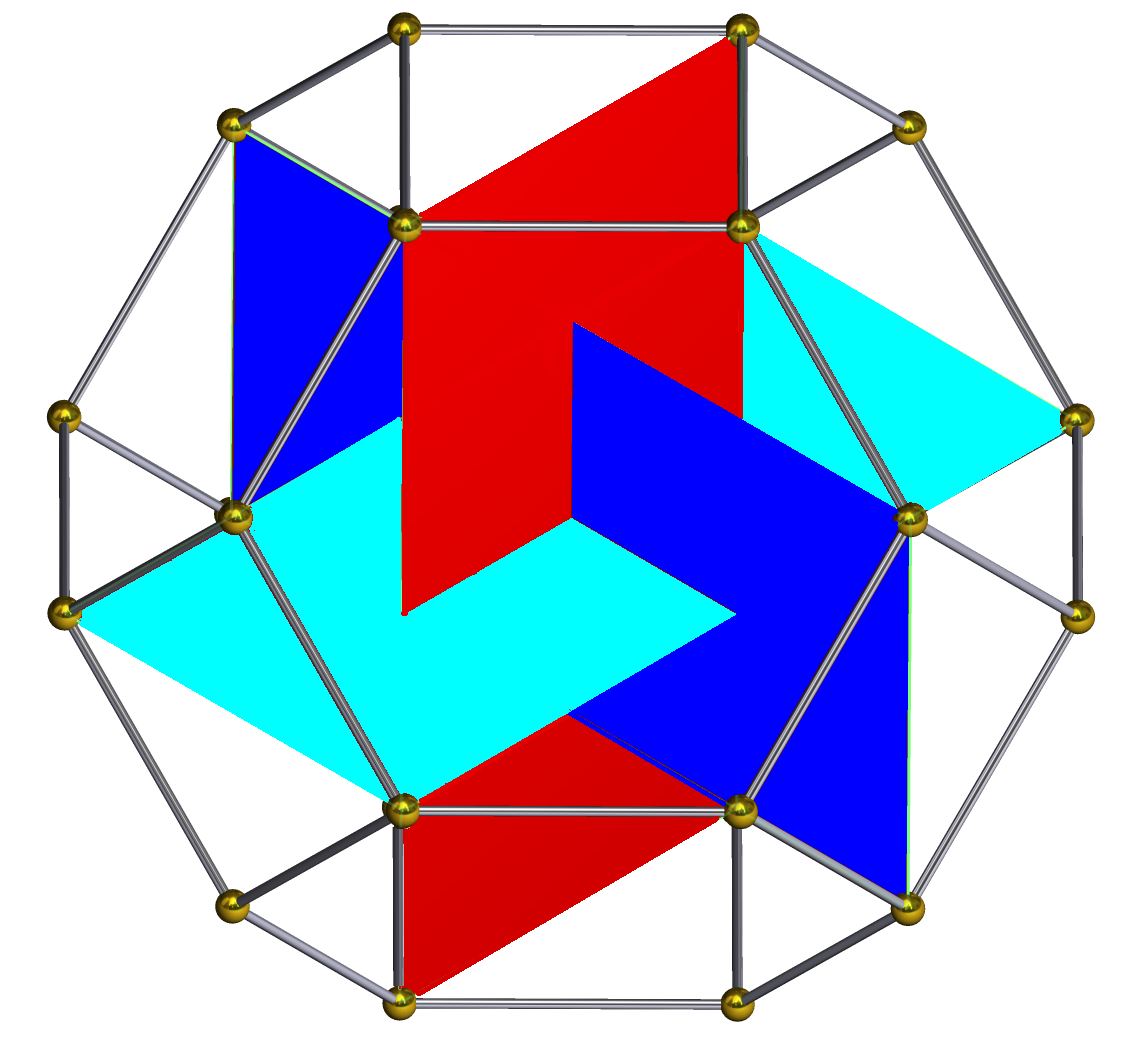
Truncated octahedron is s regular icosahedron can be distorted or marked up as a lower pyritohedral symmetry,and is called a snub octahedron, snub tetratetrahedron, snub tetrahedron, and pseudo-icosahedron - wikipedia 
There are infinitely many non-similarity (geometry) shapes of icosahedra, some of them being more symmetrical than others. The best known is the (convex polyhedron, non-stellation) regular icosahedron—one of the Platonic solids—whose faces are 20 equilateral triangles.
An Icosahedron is one of the five Platonic Solids. It is a highly symmetrical three-dimensional shape composed entirely of equilateral triangles. Its geometry is central to Syntegration, where it is used not as decoration but as a communication structure. The connections between its elements define how ideas circulate.
# Basic Properties An icosahedron has: - 20 triangular faces. - 12 vertices (points). - 30 edges (lines connecting vertices). Each face is an equilateral triangle. At each vertex, 5 triangles meet.
# Connectivity The power of the icosahedron lies in how its elements connect. Each vertex connects to 5 neighbouring vertices via edges. This creates a network where each point has equal status and equal connectivity. Each edge connects two vertices and is shared by exactly 2 faces. Each face connects to 3 neighbouring faces. This creates a highly regular and balanced structure where: - no node is central. - no node is isolated. - connections are evenly distributed.
# Circulation and "Arcs" If we think of edges as communication channels, the icosahedron provides: - 30 direct connections (edges). - multiple indirect pathways through adjacent faces and vertices. These pathways can be thought of as “arcs” of communication. An idea introduced at one vertex can travel across edges, around faces, and through the structure without needing a central hub. This is why it is useful for designing conversations. It distributes attention and interaction across the whole system.
# Dual and Symmetry The dual of the icosahedron is the Dodecahedron, which has: - 12 faces. - 20 vertices. This duality is often used conceptually: - one structure for topics. - one structure for participants. In Syntegration, this dual relationship helps map people to issues in a balanced way.
# Why It Matters The icosahedron is not just a geometric curiosity. It is a model of: - distributed systems. - non-hierarchical organisation. - balanced communication networks. Its symmetry ensures that no single point dominates, while its connectivity ensures that everything can influence everything else through structured pathways. This makes it an ideal underlying geometry for collective intelligence processes.

A rotating Icosahedron. Animated GIF image - wikimedia

Transformations of Polyhedron (jitterbug): Octahedron - Icosahedron - Cuboctahedron - wikimedia
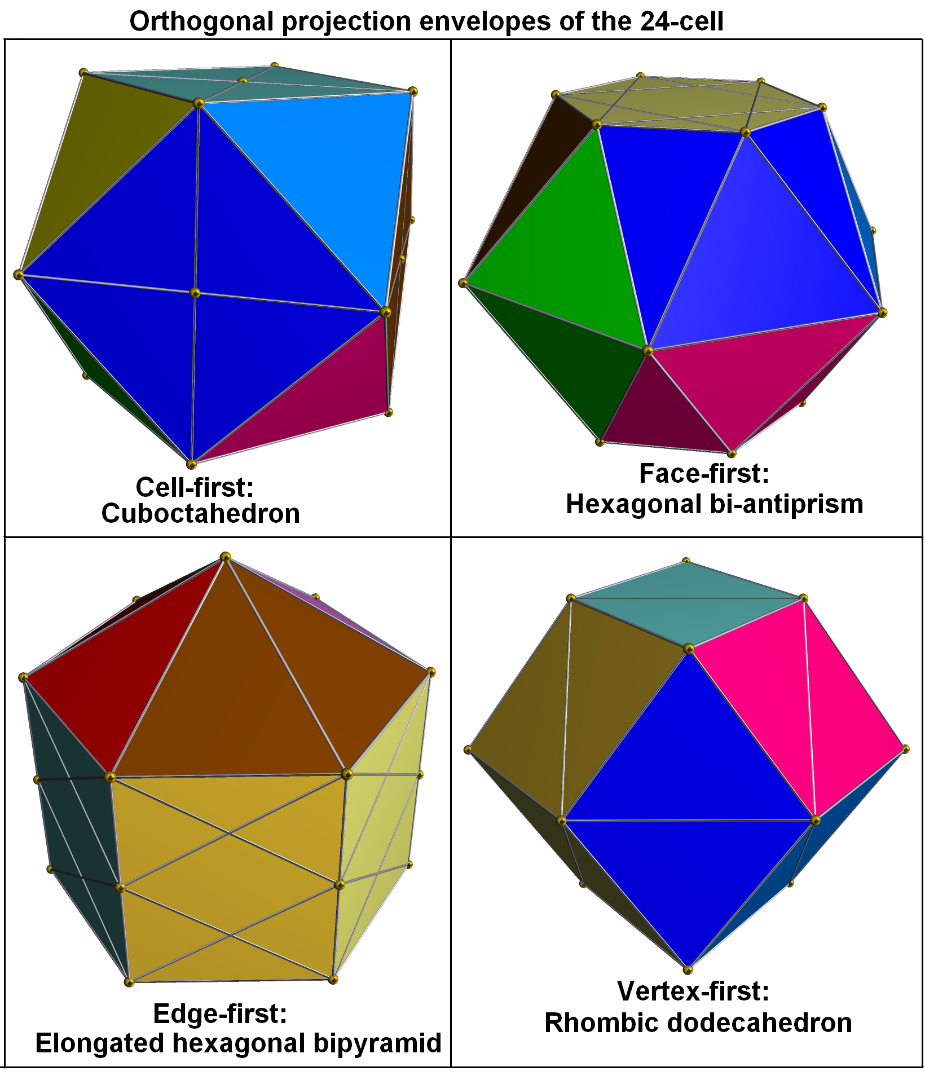
Orthogonal projection envelopes 24-cell - wikipedia and - wikimedia 
# Sections

Circogonia icosahedra, a species of radiolaria, shaped like a regular icosahedron - wikimedia
# See also
- 600-cell
Check the visual morphing of a hexahon and an internal 3D cube heree - webpack.js.org